

Autumn bird migration at Beidaihe, China, 1986-1990
(incorporating the report on China Cranewatch 1986)
Edited by Martin D. Williams
INTRODUCTION
Martin D. Williams
Beidaihe (strictly Beidaihe Haibin—North Dai River Beach: 39°47′ N, 119°27′ E), a seaside resort approximately 280 km east of Beijing, is one of the world’s finest migration watch-points. Until the mid-1980s, the migration was mainly known from studies by Axel Hemmingsen from 1942-1945 (Hemmingsen 1951, Hemmingsen and Guildal 1968) and by John de la Touche at nearby Qinhuangdao from 1910-1917 (La Touche 1920, 1921), together with occasional observations by oth-ers including G.D. Wilder and H.W. Hubbard (1924, Wilder 1923, 1924a, 1924b, 1925, 1932, 1940, 1941a, 1941b, 1941c), which showed that many migrants, including substantial numbers of cranes and Oriental White Storks Ciconia boyciana passed through the area each year. Recent studies began with a survey in spring 1985 (Williams et al. 1986, Williams 1986). This was highly successful—the results included 652 Siberian Cranes Grus leucogeranus, around 40 per-cent of the world population known at that time.
The 1985 study was followed by China Cranewatch 1986, a survey of the autumn migration. This was also successful, and observations were since been made each year to 1990.
This report summarises the results of autumn migration surveys at Beidaihe from 1986 to 1990. Results are included from the following:
1986: China Cranewatch 1986 (led by MDW; eight members, some for less than the full period), 20 August to 20 November.
1987: observations from 18 August to 30 November; 12 people (most for less than the full period) contributed to the log; data collection co-ordinated by Jesper Hornskov and John Palfery.
1988: observations from 8 September to 18 November by Jesper Hornskov (Hornskov unpubl.); survey of late autumn migration by Earthwatch teams led by MDW and Hsu Weishu (Xu Weishu)—often helped by JH, though logs kept separately, 8 October to 16 November.
1989: observations from 14-29 September and 5-6 October by Michael Fink Jørgensen (unpubl.); survey of late autumn migration by Earthwatch teams led by MDW, Hsu Weishu and Geoff Carey, 7 October to 16 November; includes observations by seven visiting Brit-ish birdwatchers present for much of this period.
1990: log kept by Jan Hjort Christensen from 19 August to 22 October, after which JHC contributed to log kept by Earthwatch teams led by MDW, Hsu Weishu and Steve Holloway, 23 October to 16 November.
- Autumn bird migration at Beidaihe, China, 1986-1990
- INTRODUCTION
- THE HABITATS AT BEIDAIHE
- METHODS
- Methods used to record passing migrants
- Variations in the degree of daily coverage
- The timing of the migration in autumn 1986
- The routes used by migrants observed passing Beidaihe
- Correlations between weather and migration
THE HABITATS AT BEIDAIHE
Stephen J. Holloway, Simon R.B. Thompson and Martin D. Williams
The areas covered in and around Beidaihe were much the same as those covered in spring 1985, the main exception being Tai-Ho Pool, which had been landscaped and made a poor habitat for birds (see below).
Though members of China Cranewatch 1986 arrived only 14 months after the 1985 survey, there had been many changes to the area, and development and the resultant habi-tat destruction were continuing. Beidaihe is one of China’s premier resorts, and its ex-pansion (which includes the establishment of a new town, Nandaihe) is having adverse ef-fects on the habitats available to migrants.
This account mainly details changes to habitats between spring 1985 and autumn 1986, with some mention of subsequent changes; further information is given by Holloway (in Williams 1986, pp. 12-22). [Note that in previous reports, including Wil-liams (1986), the Wade-Giles form of romanisation was used for localities at Beidaihe. Here, we adopt the pinyin system in which, e.g., Peking becomes Beijing and Peitaiho becomes Beidaihe.]
The south coast of Beidaihe
The shore along the south coast of Beidaihe is generally sandy, with a few rocky outcrops. Hotels, vil-las and other buildings, and small public parks, fringe the seashore. Some of the buildings—especially those from Tiger Rocks westwards—are set in large, wooded grounds (e.g. at the West Hill Hotel, which was the expedition base in 1985, but is now off-limits to casual visitors). There are several new (post-spring 1985) buildings, including hotels, especially towards Lighthouse Point. Pines and tamarisks Tamarix sp. line the beaches, to act as windbreaks.
The public gardens to the east of Tiger Rocks (near ‘Study Area Gully’) are mainly composed of planted shrubs such as Co-toneaster sp., Berberis sp., Rosa sp., Ligustrum sp., and others familiar to western horticulturists. They had become rather ne-glected and overgrown, providing dense cover for passerines. By early November, the Co-toneaster and Berberis produced a good berry crop, which attracted some passerines. The thickness of the ground cover made the area difficult to work. Further, the area suf-fered from disturbance by both local people and visitors to Beidaihe, especially at week-ends. Disturbance was much reduced by early November; interesting birds seen here during this month included Chinese Bulbul Pycnonotus sinensis, Azure-winged Magpie Urocissa cyanus and Père David’s Laugh-ingthrush Garrulax davidi (the berry crop, reduced disturbance, and good cover at a time when many deciduous trees had lost their leaves made this park especially attractive to passerines in November).
Several gullies lead down to the sea along the south coast. One of them—‘Study (Area) Gully’, which lies just west of the overgrown gardens—was visited often in 1985. This could be accessed from either the main road running east to west through Beidaihe (the top of the gully meets this road a little east of Kiesling’s) or from the road along the seafront. Both the entrances had groves of poplars Populus sp. mixed with smaller numbers of acacia Robinia sp. A few older apple trees were also present. A small boggy area proved attractive to insectivores such as Dusky Warblers Phylloscopus fus-catus and Radde’s Warblers P. schwarzi. Long grass held the occasional Yellow-legged Buttonquail Turnix tanki and skulking Lo-custella warblers. White’s Thrushes (Scaly Thrushes) Zoothera dauma frequented a walled garden beside the southern end of the gully. By autumn 1986, little had changed since 1985, although piping had been laid along the centre of the gully, reducing the stream flow in that area. By 1988, a wall had been built across the southern entrance, sev-eral bushes and trees had been damaged or removed in the middle of the gully, and rocks and rubble had been tipped in from construc-tion work at nearby buildings: however, the gully still produced good numbers of birds. A large building has since been constructed in the gully; only the upper part of the gully is worth visiting.
A stream to the east of the gardens doubled as a sewage outlet. It was lined with reeds Ty-hpa sp., dense morning glory Convolvulus sp. mats and willow Salix sp. saplings. Al-though unpleasant to work, this area together with the small, overgrown outlet to the sea held good numbers of warblers and chats.
Further east, near Legation Point, was Legation Gully. ‘Park’ was a term used by Hemmingsen (1958) for the upper part of this gully; there were maize fields here, extending to the town’s main east-west road, but con-struction work had already begun. A large belt of Thiya (?) T. orientalis and pines ef-fectively screened this area from the lower section of willows and oaks Anarcus sp. (?). A small stream with marsh surrounds flowed down towards the sea, spreading out to form a larger marshy area. This held the typical se-lection of warblers, Red-flanked Bluetails (Orange-flanked Bush-Robins) Erithacus cyanurus and flycatchers; a Baillon’s Crake Porzana pusilla was flushed from the bog-gier sections. A large sector of pines dominated the grassy centre of the gully and bordered onto a large, densely-vegetated walled garden on the eastern side—this was inaccessible, so observation was limited to birds visible from the gully.
The maize fields just north of the gully were in the process of being built over; it seemed likely that development would spread into the remainder of ‘Park’ in future years. Trees in an adjacent orchard (which had been good for warblers and Siberian Blue Robins Erithacus cyane) were cut down by mid-November. Towards the last day of the survey, wire was strung across the southern end of the gully—so development seemed imminent. In seasons immediately following autumn 1986, the habitat degradation and increased restric-tions on access made the area relatively unrewarding for birdwatching; however, it has recently proved attractive again.
Just east of Legation Point, Legation Point Gully had been effectively destroyed as a birdwatching area by the construction of hotels. The large grove of poplars at the seaward side had held flycatchers at times, but now seems near-useless for birdwatching.
Between Legation Point and Lighthouse Point, hotels occupy land which had been semi-arable with scrub. In 1986, a track al-lowed access along the beach; this had become a road by 1987 (roads now lead all along the coast of Beidaihe).
Lighthouse Point was still out of bounds to foreigners. However, two or three visits were made to the grounds of the Dong Shan Hotel, before one of the hotel staff said it was off-limits. It seemed the hotel grounds could be very good for birdwatching, being well-wooded and at a prime locality for attracting migrants which are following the coast or ar-riving from over the sea.
In subsequent years, birdwatchers visited the point, and found it productive for migrants (Hemmingsen found it to be one of the best localities in spring). They gained access through a gap in the fence on the west side of the point, and followed a track to its southern tip. This led through trees; two small gullies proved attractive to songbirds including thrushes, and a small reedbed also held birds.
The east coast of Beidaihe
Fishhook Point In spring 1985, building work began on fields above Fishhook Point. By autumn 1986, this had made the area al-most unrecognizable; there were a large, walled hotel complex many buildings and two new roads on the land which had been fields. Many of the coastal shrubs had been cleared; the only remaining vegetation which produced birds was in villa gardens and orchards adja-cent to the area. A small, reed-fringed pond which had held Baillon’s Crakes and Acro-cephalus warblers was within the hotel grounds; some visits were made to this, though the gate was sometimes locked and observers were turned away on occasions.
The sea remains worth checking for grebes, ducks etc., but in 1986 the immediate vicinity of the point seemed of little value for passer-ines. The newly-erected telephone wires were popular with gathering swallows; a building site held a selection of larks and buntings.
By 1988, much tree-planting had taken place above the shore and along the new coast road; the cover has been allowed to develop, and this area has regained some of its attractive-ness for migrant passerines.
Eagle Rock Gully The small, cultivated gully to the south of Eagle Rock had changed little since spring 1985, and remained a pleas-ant place to sit, watch and photograph birds. Warblers, chats and buntings could be found throughout the gully. The small stream flow-ing through the gully was reed-fringed in several areas and remained undisturbed most of the time. Dense peach orchards covered most of the road-side section, leading through a nursery of newly-planted trees and grafts to a well-established orchard of apples and pears (there were no citrus trees in the gully as re-ported in Williams 1986, as Beidaihe is too far north and cold for a citrus industry). Thrushes frequented the peaches, whilst a Long-tailed Rosefinch Uragus sibiricus and Azure-winged Magpies were seen in the older section (the gully was the favoured locality of Long-tailed Rosefinches in spring 1985). The only change in evidence was the uprooting of most of the older fruit trees in November. Unlike spring 1985, there was little evidence of birds been shot at.
In autumn 1987, many of the trees in the upper part of the gully (divided from the lower part by a small wall) were uprooted; building work was underway here in autumn 1988, and this upper part has since produced few birds.
Eagle Rock The development of this prom-ontory as a tourist attraction has entailed the construction of pavilions and walkways, and the siting of a genuine Mig fighter plane for souvenir snapshots (it has since been re-moved). Admission charges, though small by western standards, are strictly enforced. Dis-turbance of observers by tourists can be off-putting, but a short descent of the cliff face enables one to find a peaceful vantage point from which to survey the Sandflats and look over the sea (because of the height advantage, it is usually much easier to see grebes, ducks and other birds on the sea from here than it is from the Sandflats).
By autumn 1988, there had been little change other than the removal of the fighter plane.
The (Henghe) Sandflats
The Henghe (Heng River) runs to the sea across the Sand-flats, an estuarine area extending approximately 1.75 km to the north of Eagle Rock. The area was basically unchanged since 1985, though two artificial lakes had been built at the southern edge, and there were seats and small pavilions below Eagle Rock.
There was little vegetation on the Sandflats, except for mats of salt-tolerant species such as sea lavender Limonium sp. and glasswort Salicornia sp. A large bed of this, in the southwestern part of the Sandflats, was used as a roosting area by waders and was fre-quented by larks and wagtails, although it was frequently covered by high tides.
At the beginning of the survey, the Sandflats were covered with silt, unlike spring 1985 when the area was mostly sandy, with silt mainly restricted to the channel of the Henghe. This was apparently largely a result of tides being considerably higher than for much of the spring, often reaching to the Beidaihe-Qinhuangdao highway; the higher summer rainfall may also have helped wash silt down the Henghe to the Sandflats. This silt layer was largely gone by November, when cover-age at high tide was generally less extensive (it seems the tides tend to be lower in winter than in summer, perhaps as a result of the air pressure being usually higher in winter).
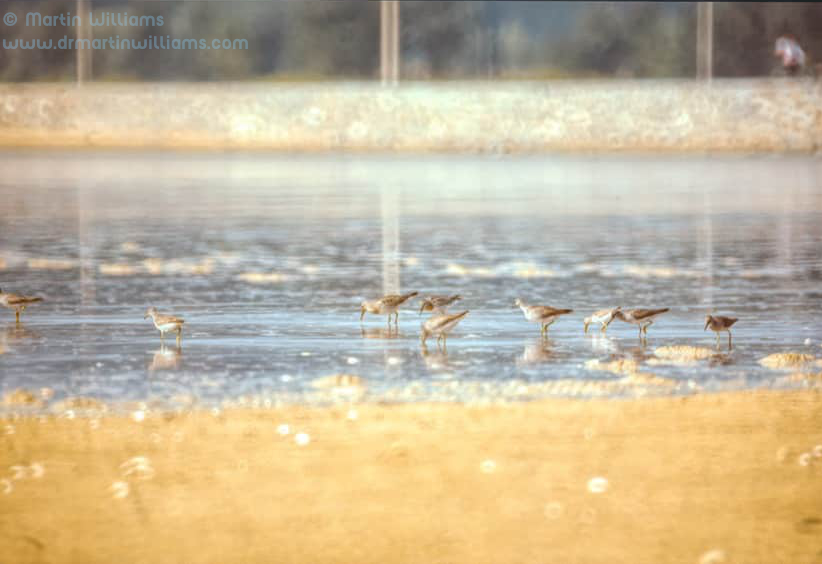
The silt evidently increased available food for birds, and the Sandflats were excellent for waterbirds such as shorebirds and gulls to early November. Shorebird numbers and di-versity were highest in the first three weeks of the survey period: in the morning of 27 August over 2000 individuals of 34 spe-cies were seen. A Nordmann’s Greenshank Tringa guttifer over 4-6 September and up to seven Relict Gulls Larus relictus in a day were the ‘star’ birds seen at the Sandflats.
Migration was often in evidence, with birds typically arriving from over the sea to the east or northeast, and heading south or southwest (over the town); or travelling down the coast. These included many of the species seen from the Lotus Hills watchpoint and some species, such as shorebirds and White-winged Terns Chlidonias leucoptera, which were seen in higher numbers from here than from the Lotus Hills, or were not recorded from the Lotus Hills. On several migration wave days, such as 27 August, passing shorebird flocks sometimes landed briefly before continuing southwards.
As in spring 1985, the area suffered from disturbance by shell and seaweed collectors and fishermen. There were also occasional hunters: a Bar-tailed Godwit Limosa lap-ponica was seen killed, and a Far-Eastern Curlew Numenius madagascariensis maimed, on 22 September.
A very conveniently situated maize field ad-jacent to the Sandflats often produced good numbers of pipits and wagtails, as well as Bluethroats Erithacus svecicus in the surrounding sparse vegetation.
Grassy Sands Hemmingsen named the area north of the Sandflats ‘Grassy Sands’. He mentions that trees had been cleared before he arrived at Beidaihe; the area was mostly grassy sand dunes, with meadows or shallow grassy ponds in late summer and early autumn. Among birds he notes as occurring, the flocks of Oriental White Storks Ciconia boyciana, cranes and Great Bustards Otis tarda are especially noteworthy; these no longer land in any numbers at Beidaihe (at least the cranes and bustards occur at the Luanhe estuary, parts of which are perhaps similar to the Grassy Sands of Hemming-sen’s time: see below, ‘Visits to other localities’).
We have retained the name for the coastal strip immediately north of the Sandflats, which is bounded to the west by the Beidaihe-Qinhuangdao highway. The area comprises a large stand of acacias, as well as several smaller plantings of Cassia sp. and associ-ated undergrowth and tall grass. Migrant passerines were seen in some numbers; it seemed that most insectivores moved on fairly quickly from here, presumably as there were relatively few insects; especially towards the end of the autumn, bunting flocks were to be found.
The area has changed little since spring 1985.
Henghe Reservoir
The small, shallow reservoir formed by the damming of the Henghe was little changed by 1986, as were its surrounds. The limited building work to the north of the reservoir was continuing, but pools and dried-out marshy areas still existed. The acacia thickets bordering the north side of the reservoir had grown considerably since spring 1985, making progress difficult. Similarly, the poplars and other vegetation along the south side also hindered progress. The reservoir itself, from approximately half-way along, was overgrown with reeds, which were systematically cut and dried by local people as the season progressed, to be even-tually used as fuel. Observations in the thickly vegetated areas were very hard, and no doubt many skulking rails and herons were missed.
The reservoir and environs proved as good as in spring 1985; birds seen included little bitterns, rails, Acrocephalus and Locustella warblers, and small numbers of ducks. Rap-tors regularly hunted the adjacent fields. The acacia thickets and undergrowth were a fa-vourite haunt of flycatchers, chats and buntings, whilst the reedy fringes produced a flock of Vinous-throated Parrotbills Para-doxornis webbianus late in October. The paddy-fields, marshy areas and channels ex-tending from the southern edge of the reservoir remained largely undisturbed.
Fishponds now occupy a large part of the area south of the reservoir; more fishponds were built to the north of the reservoir in spring 1989. Plans for a migratory birds refuge occupying the reservoir and surrounds, the Sandflats and the Grassy Sands have been drawn up (see Ounsted 1990). As a result, in 1990 the Beidaihe government established a bird reserve in the southwestern part of the area; however, no funds for development were forthcoming, and in spring 1995 a road was being built through the ‘reserve’.
There is already a reserve, administered by the Qinhuangdao Forestry Bureau, extending northwards (to the southern limit of Qinhuangdao?) from around the northern boundary of the reservoir. This is more a tree plantation than a nature reserve: partly be-cause it is difficult to grow trees here, only one species of tree is grown. It is not espe-cially attractive to birds, though passage migrants occur, the small colony of Chinese Pond Herons Ardeola bacchus found in spring 1985 is in this reserve (though not in the same location; numbers have grown, and egrets may also nest), Black-naped Orioles Oriolus chinensis are common breeding birds and two or three Common Pheasants Phasianus colchicus were seen in autumn 1988—though it is possible the latter were of captive origin, as there are captive birds at the reservoir.
Daihe (= Tai-Ho)
The Daihe flows to the sea just south of the town. The bridge which had allowed easy access to the southern shore, and thence to Tai-Ho Pool and the Yanghe, had been removed by August 1986, and work was just beginning on a new bridge. Getting across the river involved a cycle ride of several kilometres upstream, and then crossing by a makeshift ferry service. As a result of this inconvenience, and the construc-tion work which was underway, less observations were made at the Daihe and Yanghe estuaries in 1986 than in 1985. The Sandflats’ increased attractiveness to birds, and the virtual loss of Tai-Ho Pool, further decreased the incentive to make the somewhat arduous journey.
The vegetation along the Daihe was markedly similar to that of the Henghe Reservoir and Sandflats. Large tracts of reeds lined up-stream stretches, with large surrounding maize fields and small acacia thickets. Areas of glasswort and sea lavender lined the estu-ary mouth.
Tai-Ho (= Daihe) Pool In spring 1985, this small brackish pool was excellent for waders. But by autumn 1986 the channel connecting the pool to the sea had been dammed, and the pool had been landscaped into two fishponds which held very few birds. This was a great loss, both because the pool had been an en-joyable place to work, with very good views of birds present, and it was popular with such species as Long-toed Stints Calidris sub-minuta and Sharp-tailed Sandpipers Calidris acuminata which are not normally seen in numbers elsewhere.
Yanghe (= Yang-Ho) estuary and woods
The coastal strip between the Daihe and Yanghe was suffering at the hands of developers, as a new tourist resort, Nandaihe (= South of the Dai River) was under construction. The acacia woodlands were still relatively unscathed, although intensively managed and manicured by local people (who remove most dead material for use as fuel), which helped make birds highly elusive. Relatively few visits were made to the woods during autumn 1986; Spotted Bush-Warbler Bradypterus thoracicus and Grey-backed Thrush Turdus hortulorum were noteworthy species seen here.
In 1986, work was just beginning on a bridge across the Yanghe estuary. As in spring 1985, watching birds using this estu-ary proved difficult, as the area is exposed and the light for viewing distant waders was often poor. Especially earlier in the season, shorebird and gull numbers were generally lower than at the Sandflats; a Great Black-headed Gull Larus ichthyaetus was a note-worthy find. By late autumn, the Yanghe could prove better for shorebirds than the Sandflats, which was probably less attractive as most of the layer of silt had gone. Num-bers of Common Goldeneye Bucephala clangula frequented the river and estuary mouth in November.
Raptors such as harriers often hunted over the adjacent rice paddies and fields, and partly because of the flatness of the area the Yanghe was a good place for observing visible migra-tion. The rice paddies and marsh in the area often held crakes, warblers and buntings; a splendid Chinese Grey Shrike Lanius sphe-nocercus was seen several times.
By autumn 1988, the Daihe and Yanghe bridges had been completed and a road crossing them led south from Beidaihe, along the coast, and eventually to Changli. Nandaihe had expanded considerably. The south shore of the Yanghe was accessible by the bridge; extensive fishponds here hold gulls and shorebirds when the water is mostly drained out, and a small channel formed by the river often held Saunders’s Gulls Larus saundersi and Relict Gulls in autumn 1987.
Lotus Hills
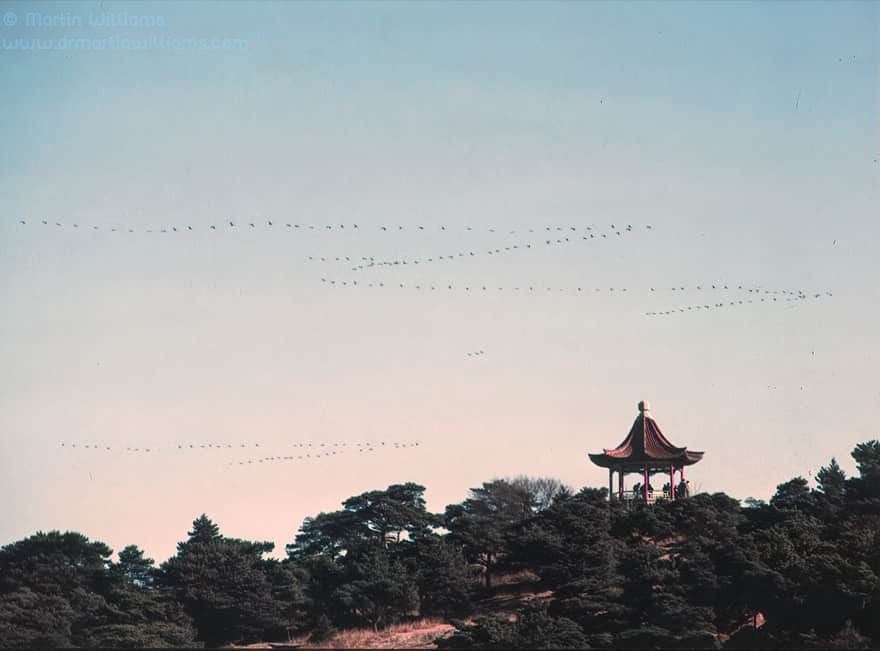
As in spring 1985, the bulk of the observations of visible migration were made from the Lotus Hills, which lie to the west of town and are 150-160 m high at most. However, when observers first visited the 1985 watchpoint, at the top of the easternmost hill, they were told to leave by soldiers (army training exercises are sometimes carried out on the southeastern flank of this hill). After briefly trying the highest of the Lotus Hills, which lacked a suitable vantage point (obser-vations from a hilltop pavilion were marred by trees partly blocking the view, and by num-bers of visitors), we began observations from a rocky knoll lying below, and to the west of, this main hill. This afforded excellent views to the south, across the plain to the west, and north to the mountains above Shanhaiguan, though the hill blocked much of the view to the east, towards the town and the sea. It was a pleasant place from which to watch birds—if a little exposed at times. It was a good vantage point for observing passing mi-grants, though views of those which passed to the east of the Lotus Hills (notably most of the cranes) were often poor.
The dominant vegetation around this vantage point was pine, mixed with smaller stands of oak and cherry Prunus sp. The ground cover included such species familiar to western gar-deners as iris Iris sp., day-lily Hemerocallis sp. and wild orange zinnia Zinnia sp.
In early autumn, large black and yellow spiders were remarkably abundant; it could seem their webs were strung between every tree away from the main paths.
Especially in late autumn, local people scoured the woods for dead plant material for use as fuel. Leaves and dead branches were swept up, dead-looking branches on trees were tapped to check if they were still alive, and removed if not, and we even saw people shaking pine trees vigorously, then sweeping up the needles. This surely limits the value of the area for wildlife.
There were several small reservoirs and ponds in the foothills, which tended to differ from one another in their associated vegetation and the birds attracted to them. ‘Kingfisher Pond’, visible to the west of the watchpoint, was shallow and surrounded by willows and reeds—the Common Kingfisher Alcedo atthis was the prominent species early in the survey period. ‘Osprey Pond’, below the watchpoint, to the north, was mainly used as a stock-watering and carp-raising pond: two Ospreys Pandion haliaeetus which spent up to four weeks in the area were seen to ex-ploit this easy source of food. Mandarin Ducks Aix galericulata were seen at ‘Mandarin Pond’ and ‘Hidden Pond’. The former, near the bottom of a small valley to the south of the watchpoint, lacked any shoreline vege-tation whilst Hidden Pond was well-concealed by thick vegetation and overgrown orchards (it was only discovered after the bulk of the thrush and warbler migration was over).
There were old rice paddies and marshes below Mandarin Pond. Two Watercock Gallicrex cinerea and a Schrenck’s Bittern Ixobrychus eurhythmus were notable in early September, Hobbies Falco subbuteo lingering around the hills were watched hunting here, and the paddies and the fringes of Mandarin Pond were popular with buntings in late autumn.
Orchards—both apple and pear—surrounded the northwestern slopes of the Lotus Hills. These were excellent for buntings, and for Siberian Accentors Prunella montanella late in the season.
At least five songbird-trapping sites were found. These were mostly in operation in October and November, when quarry species were Eurasian Siskins Carduelis spinus, Hawfinches Coccothraustes coccothraustes and Japanese Grosbeaks Eophona personata. There was also a hawk-trapping site, which was primarily operated in October and November; the quarry was young Northern Goshawks Accipiter gentilis (see below, ‘Hazards facing migrant birds at Beidaihe’).
Temple Gully (Hemmingsen’s name; the area had been called Lotus Hill Gully in spring 1985) runs from the Twin Bridges, past a small temple, and finishes below the gap between the highest and easternmost hills. It had changed little since spring 1985, and regularly produced White’s Thrush, and the autumn’s only Siberian Thrush Zoothera sibirica.
Access to West Hill Gully was not easy, since the West Hill Hotel (the expedition base in 1985) had closed, and the only way we found to the gully was down Temple Gully, which ‘becomes’ West Hill Gully down-stream of the Twin Bridges. The west side of the gully, with its paths and orchards, had been taken over by the West Hill Hotel, and work was underway on a wall to complete this separation (it was fenced off by barbed wire) and build a paved path along the eastern bank of the stream. Because of the access problems and the ongoing changes, few visits were made to the gully.
To access the Lotus Hills, we used the entrance on the eastern flank of the highest hill, reached by a road leading up from the town. An entry fee was charged here (small by western standards), though we eventually persuaded the ticket collectors to let us in free (and anyway often arrived before they did).
By autumn 1988, the wall in West Hill Gully had been completed, as had the path. Another entrance to the Lotus Hills had been built, just above the West Hill Hotel, and en-abled easy access to the gully. The spring 1985 watchpoint was used by observers in late autumn 1987, 1988, 1989 and 1990, and proved excellent for the cranes, though it may be that migrants such as harriers and passer-ines are better counted from the rocky knoll.
A nature reserve—‘The Hundred Birds Park’—has been established in the western Lotus Hills by the Beidaihe Parks and Gar-dens Authority.
The Diplomatic Personnel Guest House, our base in autumn 1986, lies on the seafront, just to the north of Tiger Rocks. There are well-established pines and oaks scattered amongst the old villa-style gardens. There are trees and some dense vegetation in a small gully beside a pavilion, which was worked most days. Flycatchers and Phylloscopus warblers fed here, along with the occasional White’s Thrush, and a Large Hawk Cuckoo Cuculus sparverioides was seen during 12-16 September.
Pines and Thiya at the western part of the hotel—both in and adjacent to the grounds—held a Long-eared Owl Asio otus roost towards the end of the survey, the highest count being 25 birds on 19 November.
METHODS
The methods were similar to those of the 1985 survey (Williams 1986), with observa-tion (using binoculars and telescopes) providing the means of data collection. The great majority of passing migrants noted during the surveys were recorded during pe-riods of prolonged observation from suitable vantage points, notably the Lotus Hills. Daily counts were made of migrants present at areas representing the various habitats in and around Beidaihe.
The 1986 and Earthwatch surveys placed special emphasis on recording actively mi-grating birds, through maintaining observations from vantage points at the Lotus Hills, at the western edge of town. This was because the totals of passing migrants re-corded at Beidaihe can be significant, and comparison of results from different seasons is relatively straightforward.
During the other survey periods, there was also good coverage from the Lotus Hills watchpoints, though this was less systematic.
During the 1986 and Earthwatch surveys, records of birds at the various localities in and around Beidaihe were logged. Otherwise, to-tals of birds present in or migrating over the Beidaihe area were recorded.
Methods used to record passing migrants
The main locality for recording passing migrants was the Lotus Hills. In spring 1985, observations were made from the southeastern hill. This is a little lower than the ‘main’ hill, to the northwest, and views to the west and northwest are obscured. However, there are excellent views in other directions. Soon after members of the 1986 team began obser-vations began here in autumn 1986, they were waved away by soldiers (the watchpoint is near a military area). Other sites on the main hill were tried, but none proved satisfactory— trees obscured views and there were too many visitors, and a rocky outcrop west of the main hill was chosen as the watchpoint for much of the autumn. This is lower than the southeastern hill, and views to the east are poor as they are blocked by the main hill (most of Beidaihe cannot be seen), but views over the plain are excellent.
This outcrop proved a good vantage point, but in 1986 most cranes passed to the east of the Lotus Hills, with flocks disappearing be-hind the main hill for long periods, or only located as they appeared over the southern slope of the hill, often too distant for identifi-cation. Largely to obtain better views of the cranes (and possibly record more, and identify a higher proportion), observations were made from the southeastern hill in late autumn 1987, and during the Earthwatch surveys (there was no trouble from soldiers). The rocky outcrop was regularly used as a watchpoint in 1987 until 20 October and in 1988 to around mid-October, and occasionally thereafter; Hornskov (1989) considers it better than the southeast hill for recording migrating small passerines. It is probably also better for recording the birds which mainly pass over the plain, e.g. raptors and storks.
Greater care was taken with counts and es-timates of numbers of birds in flocks of cranes and storks than, say, Rooks Corvus frugilegus or Carrion Crows C. corone. Thus flocks of Rooks or Carrion Crows were typically ‘counted’ by one observer, who might make a fairly quick estimate of, say, 60 birds (perhaps by counting ten birds, then estimat-ing how many tens the flock contained), which was entered in the log.
Crane and stork flocks were often counted by more than one observer, the figures only being announced once all counts were complete. In some cases, perhaps after re-counts, the figures agreed exactly and were entered in the log. In others, a ‘best’ figure was chosen, or an average was entered. We found that counts might produce the same figure for even the larger flocks of cranes, perhaps with over 300 birds (the largest ‘flocks’ are usually groups of crane formations, each of which can be counted separately). This suggests that even the larg-est crane flocks can be counted accurately. Problems can arise, however, on ‘wave’ days, when flocks may pass in quick succession, not allowing time to repeat counts.
Whenever possible, flocks of birds which use thermals to gain height and so minimise energy use during migration were not counted as they ‘thermalled’, as at this time they are probably impossible to count with any accu-racy (cranes, storks, raptors, swifts and crows all use thermals in this manner). If the birds were in a thermal when they were located, we found it best to wait until they began heading off from the top of the thermal (as raptors do), or re-grouped into the flock formation (e.g. cranes) before we began counting.
To minimise over-recording of passing large birds such as storks, cranes and raptors by entering records in the log for the same birds seen from more than one locality, numbers of birds, flight paths and times were compared. If it appeared that birds had been seen from more than one locality, only one observation was entered in the log. For small birds, espe-cially passerines, all observations were logged as it was assumed that the great majority of those seen from the Sandflats would be dif-ferent to those seen from the Lotus Hills.
During the 1986 and Earthwatch surveys, totals entered in the log were simply the sums of all counts. In 1987 and 1988 (Hornskov 1989) the totals were rounded up or down somewhat arbitrarily if it was felt this better reflected the true accuracy of the figure, which might be largely derived from approximate counts, e.g. a total of 232 might be rounded down to 230.
Variations in the degree of daily coverage
The following factors influenced the degree of daily coverage.
Number of observers The number of observers during the surveys fluctuated, ranging from one to ten or more (typically three to seven). The main periods with one observer were 8 September to 7 October 1988, 14-29 September 1989 and 19 August to 22 October 1990 (though, especially in 1990, there was some help from birdwatchers who visited during these periods), and the last ten days of November 1987.
Variation in weather and numbers of birds grounded or passing As in spring 1985, the weather was rarely solely responsible for affecting the degree of coverage of the area: there were a few days when heavy rain or snow prompted observers to shelter in hotel rooms (considerable migration was sometimes evident once the weather began clearing—i.e. a cold front was moving away to the east).
In 1986, the Lotus Hills observations were made daily, weather permitting. The watch-point was manned on a rota basis, with rarely less than two observers present; observation periods totalled 853.6 hours (2624 man-hours)—an average of around 9.25 hours per day. Initially, observations typically began by 07h30; the starting time became earlier as Pied Harriers Circus melanoleucos could be passing in numbers soon after dawn, and sev-eral watches in September began at 06h30 (Beijing summer time; just before sunrise).
The observations typically ended by 15h00-16h00 (rarely 12h00-13h00 on very quiet days), once continuing to 18h40 (on 12 September, a day of heavy migration). Later in the autumn, observations tended to start and finish later (often 06h30-07h00 to 16h00-17h00, winter time: China has since abandoned summer time). This was because fewer birds were passing in the early morn-ing, and cranes, especially, were mainly seen in the afternoon. Again, observations were cut short if there was very little passing, prolonged if there was heavy migration, and began earlier than normal if the weather seemed promising.
Lotus Hills observations during the Earthwatch surveys roughly followed the late autumn pattern, though were more likely to be abandoned if little was passing and conditions were not promising, and there were no observations at Beidaihe on a few days when other localities were visited (on all these days, the weather seemed poor for migration).
RESULTS
The timing of the migration in autumn 1986
Martin D. Williams
The timing of the migration noted by each of the autumn surveys was broadly similar. The following account is based on the autumn 1986 survey, and indicates the birds seen as the autumn progressed. (see also Appendix.)
During the initial part of the survey, in late August, the daily maximum temperature re-mained at around 30°C (the range was 28.5-33°C), and minimum temperatures were be-tween 21.2 and 24°C.
Shorebirds are among the earliest autumn migrants at Beidaihe (the records of La Touche 1920, 1921 and Hemmingsen and Guildal 1968 suggest that the peak of autumn shorebird migration at Beidaihe occurs around the end of July and early August), and occurred in numbers, with over 2000 individuals of 34 species recorded on the 27th.
White-winged Terns Chlidonias leucopterus were also common, the maximum count being 900 on 30 August (Hemmingsen had noted ‘countless numbers’ passing down the coast as early as the end of June). Over 9000 Pacific Swifts Apus pacificus were logged between 20 August and the end of the month, almost half this total passing in just two hours in the afternoon of the 30th.
The survey’s first Relict Gull Larus relictus—and the only adult of this species seen during the autumn—was at the Sandflats on 23 August.
Arctic Warblers Phylloscopus borealis, Yellow-rumped Flycatchers Ficedula zanthopygia, Sooty Flycatchers Muscicapa sibirica, Grey-streaked Flycatchers M. griseisticta and Asian Paradise Flycatchers Terpsiphone paradisi were among the early passerine migrants.
Counts of passing migrants were rewarding during the first half of September, when nota-ble totals included 2874 Pied Harriers Circus melanoleucos and 170 White-throated Needletails Hirundapus caudacuta on 10th, and 170 Crested Honey-Buzzards Pernis pti-lorhyncus orientalis, 2957 Pied Harriers, 152 Japanese Sparrowhawks Accipiter gularis and 915 Oriental Pratincoles Glareola maldivarum on 12th. In the early mornings, actively migrating passerines were evident, with counts including 483 Richard’s Pipits Anthus richardi on 13th, 1438 Yellow Wagtails Motacilla flava on 6th and 189 Chinese
Grosbeaks (Yellow-billed Grosbeaks) Eophona migratoria on 7 September.
The variety of passerines increased as September progressed, with the first sightings of species such as the Siberian Rubythroat Erithacus calliope, the Red-flanked Bluetail (Orange-flanked Bush-Robin) Tarsiger cyanurus, the Chestnut-eared Bunting Emberiza fucata and the Black-faced Bunting E. spodocephala during the second half of the month. There were two first-winter Relict Gulls at the Sandflats on 8 September; sightings of first-winter birds were to continue to the end of the survey.
For much of the period between mid-September and the second week of October the weather was stable (anticyclonic) and observations from the Lotus Hills were rather unproductive.
Songbird movements continued, e.g. 238 Olive-backed Pipits Anthus hodgsoni were logged on 24 September and 951 Chestnut-flanked White-eyes Zosterops erythropleura headed south on 20 September, and there were good numbers of Barn Swallows Hirundo rustica and Red-rumped Swallows H. daurica, with totals of over 950 and 2700, respectively, on 4 October. However, the numbers of raptors were generally disappointing, the highest tally being 500 Pied Harriers on 20 September.
On 23 September, 3504 Grey-headed Lapwings Vanellus cinereus were recorded from the watchpoint.
A sizeable influx of Radde’s Warblers Phylloscopus schwarzi was noted on 28 September, when 159 were recorded. Though this was the main species involved in the ‘fall’, there were good numbers of other grounded passerines, including six Siberian Rubythroats, eight Bluethroats Erithacus svecicus, five White’s Thrushes (Scaly Thushes) Zoothera dauma, 28 Lanceolated Warblers Locustella lanceolata, 114 Yellow-browed Warblers (Inornate Warblers) Phylloscopus inornatus, 21 Red-throated Flycatchers Ficedula (parva) albicilla and 209 Black-faced Buntings.
A cold front moved eastwards over Beidaihe late on 9 October, and there was a flurry of migration the next day, when 146 Grey Herons Ardea cinerea, 160 Purple Herons A. purpurea and 16 species of raptors—including 56 Northern Goshawks Accipiter gentilis, 319 Common Buzzards Buteo buteo and five Greater Spotted Eagles Aquila clanga—moved south.
From this date to the end of the survey period, the weather reverted to the periodicity which appears typical of northeast China (Hemmingsen 1951), and successive arrivals of northerly air-streams, usually preceded by cold fronts, stimulated further ‘waves’ of migration. Cranes and geese began to occur in some numbers, and Upland Buzzards Buteo hemilasius were fairly common, the maximum count being 102 on 28 October.
The first large Oriental White Stork Ciconia boyciana flock—numbering ca. 280 birds (over one-quarter of the known world population prior to the survey)—was seen at dusk on 29 Oc-tober.
The highest day totals of Common Cranes Grus grus and Hooded Cranes G. monacha—1269 and 438, respectively—were logged on 5 November. The next day, Oriental White Stork numbers peaked, with a total of 742 resulting from just three sightings (flocks of ca. 360 and ca. 380, and two).
The overall migration declined markedly in November, when most winter visitors became established. Late records included a Red-throated Flycatcher on 17 November.
The Henghe Reservoir and the Sandflats were largely frozen over on 16 November, by which date there were relatively low numbers of passing birds, even on days with apparently good migration weather. Goosander (Common Mergansers) Mergus merganser were the last of the waterfowl to occur in numbers; 400 were recorded from the Lotus Hills watchpoint in the last week of the survey. Red-crowned Cranes Grus japonensis, which seem to be the most cold tolerant members of the genus to pass Beidaihe, continued to occur in small numbers, and the peak count of Great Bustards Otis tarda—70 birds—was made on 17 November.
The routes used by migrants observed passing Beidaihe
Martin D.Williams
Most migrants observed passing Beidaihe followed the trend of the coast—i.e. flew from the northeast towards the southwest. Many overflew the town, rather than fly around the roughly triangular headland Beidaihe occupies.
La Touche (1914) also found that birds tended to follow the coast in the autumn: ‘The birds when bound south appear generally to follow the coastline, and many species may be observed by day, skirting the coast or passing overhead, either over Chingwangtao [= Qin-huangdao] or not far inland.’ Wilder (1924a) observed smaller birds ‘coming across the gulf [of Bohai]’, and suggests that: ‘Probably the migration route for them follows the China coast only approximately, cutting off the gulf by flights across rather than going around, as the waterfowl seem to do, so that their line of flight is southwest.’ He says La Touche also found that smaller birds crossed the gulf, yet it seems that La Touche only found this was the case in spring (La Touche 1914). From our observations, it seems that the birds arriving from across the gulf—which may include raptors, cranes and others, as well as passerines—may have only taken a short cut from near Shanhaiguan, over the sea to Beidaihe, rather than following the curve of the coast. Radar studies would help with determining routes of birds passing through the area—and show to what extent the migration is concentrated over Beidaihe.
Shorebirds and terns were good examples of birds taking the short cut over Beidaihe. From observations at the Sandflats (few were seen from the Lotus Hills, as they passed too far to the east), it appeared they tended to pass down the coast to the Sandflats, then head over Beidaihe before continuing on down the coast.
Cranes also mainly passed over Beidaihe, or even out over the sea. Some 3091 (65 per-cent) of the 4779 cranes for which routes were noted in 1986 passed to the east of the Lotus Hills (much to the frustration of the observers, since the highest Lotus Hill se-verely restricted views in this direction from the 1986 watchpoint). Though routes were not noted in later autumns, the majority of cranes again passed to the east of the watch-point. This contrasts with the spring, when it seems the tendency is for the birds to pass over the plain, perhaps accounting for Hem-mingsen’s autumn crane totals mostly well exceeding his spring totals. The larger flocks were especially prone to pass over the town or sea, perhaps as they were led by birds well used to travelling down the coast (smaller flocks, as they have fewer birds, are less likely to have ‘old hands’).
By contrast to the cranes, the majority of Oriental White Storks passed over the plain inland of Beidaihe: 1565 (66 percent) of the 2358 birds for which routes were noted in 1986 passed to the west of the Lotus Hills. Black Storks showed an even higher ten-dency to pass over the plain; several flocks were seen well to the west of Beidaihe (ap-pearing distant even through telescopes): this may reflect the species’ liking for roosting in mountains as well as in lowland fields and wetlands, which are probably the preferred roosting habitats of the Oriental White Stork.
Raptors also mainly passed over the plain, though their routes were perhaps affected more by wind direction than those of the above species. Northwest winds were usually the most productive for raptors, suggesting that the birds had been drifted eastwards from a more typical route to the west of Beidaihe.
Further evidence for a more westerly route is provided by occasional observations at Shanhaiguan, ca. 30 km north of Beidaihe. Raptors—and Black Storks—have been noted passing in fair numbers over the mountains east of Shanhaiguan on days when little migration was evident at Beidaihe, or the weather conditions were much as on very quiet days for migration at Beidaihe (see ‘Visits to other localities’).
There was perhaps a tendency for raptors to pass over the town and the Lotus Hills more in the morning than the afternoon, when the main route was over the plain: e.g. on 11 October 1988, when ca. 1100 Common Buzzards were logged, birds passed over the town and Lotus Hills in the morning, the route was roughly centred over the Lotus Hills by midday, and birds seen in mid afternoon were mostly passing well to the west. This may result from thermal developments during the day. So, presumably, does the tendency for raptors to be lower during early morning than around mid morning to early afternoon, when Pied Harriers, especially, were sometimes so high that they could only be detected with binoculars.
Small passerines migrated over a broad front, overflying Beidaihe (the Sandflats was a good locality for recording early-morning passerine movements) and the plain, though there were no records of any numbers pass-ing over the sea east of town. As with several other birds, it appeared there was a tendency for them to arrive from over the sea to the east of town, and fly westwards or southwest-wards overland. This may reflect the use of the Beidaihe headland, and especially the Lotus Hills, as landmarks in an otherwise flat coastline. As noted above, the rocky outcrop at the Lotus Hills may be a better watchpoint for recording actively-migrating small passerines than the southeastern hill.
The passerine migration on a given day may not be over a broad front, and there may be great differences in numbers recorded at different localities. Good examples are 11 October 1988, when 2715 Chinese Penduline Tits Remiz pendulinus were recorded from Daihe, yet only 50 from the Lotus Hills, and 13 October 1988, when 4500 Northern Skylarks Alauda arvensis were recorded from Daihe, and only 144 from the Lotus Hills. The wind was force four to five on both these days, northwest to west on 11th and westerly on 13 October, and the birds may have been flying low as a result (substantial numbers of actively migrating small passerines have been recorded from the Lotus Hills on other days).
Correlations between weather and migration
Martin D. Williams
Hemmingsen (1951) notes that, in north China, weather variables such as temperature and air pressure show periodic fluctuations, with typical intervals between highs and lows of the variables of five to seven days. The numbers of migrants seen at Beidaihe are strongly dependent on these fluctuations in weather, and some birds, e.g. cranes, have ap-parently evolved migration strategies which involve them waiting for optimum migration conditions before undertaking the stage of their journey which passes Beidaihe.
These optimum conditions typically include winds with a northerly component, especially after a cold front has passed east over the area, and may lead to spectacular ‘waves’ of visible migration.
Thousands, or tens of thousands, of birds may also occur during ‘falls’—arrivals of grounded migrants, typically with very little visible migration. These falls apparently mainly coincide with falling air pressure.
The periodic changes in weather thus serve to stimulate migration, and migration waves and influxes are fairly frequent, though may differ strongly in the numbers of birds in-volved. However, stable, anticylonic weather can result in little evident migration, even though skies are normally clear (i.e. birds would not experience navigation problems). It may be that this is partly because winds are light and variable, and birds prefer to wait for a wind with a more consistent northerly component; also, the typically warm weather during these conditions will help ensure that food is still available.
Weather stimulating migration waves
As mentioned, waves of visible migration were sometimes noted after the passage of cold fronts—i.e. in classic autumn migration weather (Elkins 1983). Typically, it becomes increasingly hazy prior to the arrival of a front, it may be warm, and there is little mi-gration (there may be good numbers of grounded birds; see below). The arrival of the front is marked by the sky becoming overcast and, as the front passes over, heavy rain or snow may fall, and the wind swings towards west to north, and becomes fresh or strong. The rain or snow eventually eases, and the visibility becomes good or very good, and the sky eventually clears (sometimes, the wind may not freshen until the cloud has passed to the east).
An excellent example of a cold front which stimulated a migration wave passed Beidaihe during 14th and 15 October 1989. The front arrived late on 14th, and it was raining, with a fresh north wind, in the early morning of 15th. Observations from the Jin Shan Hotel, eastern Beidaihe, produced over 200 unidentified ducks heading south over the sea, but few other passing migrants while it was raining. However, as soon as the rain eased at around 09h00, Grey Heron migration was evident; 1417 were recorded by observers at the east coast of Beidaihe from this time to 11h30. Two White Spoonbills Platalea leucorodia and 135 Great Cormorants Phalacrocorax carbo were also of note during the morning. There was something of a lull around midday, but with the sky clearing and the wind from the north (cold), the afternoon produced most of the day’s totals of 21 Black Storks Ciconia nigra, 26 Eurasian Sparrowhawks Accipiter nisus, 26 Northern Goshawks A. gentilis, 427 Common Buzzards Buteo buteo, 1167 Daurian Jackdaws Corvus dauuricus and 2693 Rooks Corvus frugilegus or Carrion Crows C. corone.
The following day, the wind remained northerly, fresh, in the early morning (became light by 08h00, and westerly from mid-morning onwards), the sky was clear, and the wave continued, with 52 Eurasian Sparrowhawks, 41 Northern Goshawks, 740 Common Buz-zards, three Saker Falcons Falco cherrug, 33 Great Bustards and 2303 Rooks or Carrion Crows.
Another cold front arrived on 7/8 November 1990. It cleared Beidaihe by dawn on 9 November; during the day, the sky was clear, the visibility excellent, and the wind moderate north-northeast in the early morn-ing, becoming northwest by mid-morning, and westerly by mid-afternoon. The day was especially notable for birds of prey, with 13 species including three White-tailed Eagles Haliaeetus albicilla, six Eurasian Black Vultures Aegypius monachus (in a party, flying north), 190 Upland Buzzards, four Rough-legged Buzzards Buteo lagopus, one Greater Spotted Eagle, one Steppe Eagle Aquila nipalensis and one Imperial Eagle Aquila heliaca. There were also 135 Oriental White Storks, four Black Storks Ciconia nigra, 491 Common Cranes (441 were seen from 15h00-17h00), ten Red-crowned Cranes and 14 Great Bustards.
The next day, the sky was again clear, and the wind north-northeast at first. But the wind soon became light, and variable after 10h00, becoming southerly by midday, by which time only rather low numbers of migrants had been seen; the only cranes were 20 Commons and five which were unidentified.
But, soon after 28 Commons flew north, a flock of 85 Common Cranes flying south at 12h40 marked the start of the best crane pas-sage in recent years (with birds seen all flying south). The day’s crane totals were 2728 Common 328 Hooded, 135 Red-crowned, and 111 Siberian Cranes, six White-naped Cranes Grus vipio and 396 unidentified cranes.
A third example of a cold front stimulating migration is one which passed Beidaihe over 13th and 14 November 1986, clearing the area by the morning of 14th. Though rather late in the autumn, 14 November produced a fair migration wave, with totals including 277 Oriental White Storks, 43 Upland Buzzards Buteo hemilasius, three White-tailed Eagles Haliaeetus albicilla, 111 Common and 61 Red-crowned Cranes, 31 Great Bustards, 344 Daurian Jackdaws and 1042 Rooks or Carrion Crows.
Hemmingsen’s records indicate that he similarly observed migration waves after cold fronts had passed, e.g. ‘the big goose climax in the autumn of 1943 [ca. 2400 geese; also ca. 1000 cranes] came after a strong East storm which brought with it the temperature fall, but on the day of the maximum migration the weather was calm and thus appeared mild.’ (Hemmingsen 1951).
Fast moving cold fronts as on 14/15 October 1989, 7-9 November 1990 and 13/14 November 1986 mainly occur in late autumn, from mid-October onwards (they may move from northwest China to the southeast of the country in only two or three days). They are not the only weather features to give rise to substantial migration wave conditions at Beidaihe, though it appears waves mostly occur as the air pressure rises, i.e. on the eastern flanks of high pressure cells, where winds have a northerly component (the opposite of the case in spring, when migration waves are associated with the western flanks of high pressure cells).
An example is the wave on 12 September 1986, when totals in-cluded 2957 Pied Harriers, 152 Japanese Sparrowhawks and 915 Oriental Pratincoles. Though no active front was noted, weather conditions were as for the arrival of a high pressure cell: the air pressure rose from 11th to 12 September; the minimum temperature fell from 22°C over 10-11 September to 15°C over 11th-12th; visibility improved from less than 8 km with increasing haze on 11th to over 15 km on 12th; the sky was partly cloudy on 11th, clear on 12th. The wind on 12th was northwesterly, force 2, in the early morning and became westerly, force 2, for much of the day from mid morning onwards.
A wave similarly occurred with rising air pressure on 29 October 1986, when totals included 359 Oriental White Storks, 590 Bean Geese, two White-tailed Eagles, 412 Common, 35 Red-crowned, nine Hooded, two White-naped and 49 Siberian Cranes and 13 Great Bustards. Though the weather remained fine the next day, the wind was southwest from mid-morning onwards, becoming force four to five by early afternoon, and little mi-gration was evident, with totals of just three Oriental White Storks, three Bean Geese and 11 Common Cranes (no White-tailed Eagles or cranes other than Common). The weather synopsis for this day is much as for crane wave days in spring, so the low numbers of migrants presumably reflect the strong influence of wind direction on crane migration.
Often on wave days, the sky is clear or partly cloudy and there is no rain. But water-fowl, especially, may pass in numbers during rain (they are better insulated, and so experi-ence less heat loss, than most land birds). The most notable example was a wave of of geese, ducks and waders on 29 October 1987, when totals included 2150 Bean Geese and 10,500 Northern Lapwings Vanellus vanellus. It was overcast, calm in the early morning; there was a fresh northeast wind from around 07h30 and rain began around 09h00, lasting until 15h30. Though some migration was noted in the morning, it was not until around 11h00 that birds began passing in numbers, with large flocks of geese and Northern Lapwings heading towards the southwest over the southern coast of Beidaihe (most were seen from the Diplomatic Personnel Guest House).
We have found that, as on 30 October 1986, days with southwest winds produce little visi-ble migration. This agrees with the hawk trappers who told Hemmingsen (1951) that few birds pass on days with southwest winds.
A hawk trapper we spoke to said northwest winds are best for raptor migration at Beidaihe, in agreement with our observations. Such winds will stimulate migration as they have a component in the migration direction; as noted above, they may produce the highest raptor numbers at Beidaihe as the west com-ponent drifts birds eastwards from a more westerly route. Our observations indicate that cranes, and perhaps Oriental White Storks, geese and other birds, prefer northeast winds—i.e. winds close to, or exactly in, the migration direction.
The weather which prompts visible migration may result in large ‘clearouts’ of migrants present in the area, which can be all the more obvious as there may be falls as cold fronts approach (see below). A good example was 15 October 1989, when, although attention largely focussed on visible migration, there were no records of Red-flanked Bluetails (37 were logged on 14th), only one Black-browed Reed Warbler Acrocephalus bistrigiceps (26 on 14th) and no Dusky Warblers Phylloscopus fuscatus (13 on 14th). Several species had been fairly common before this date, but were recorded in far smaller numbers afterwards, e.g. the Black-browed Reed Warbler, the Radde’s Warbler, the Red-throated Flycatcher and the Chestnut-flanked White-eye.
Falls ie influxes of migrants
Weather leading to influxes Influxes of migrants appear to mainly coincide with falling, or low, air pressure (low pressure tends to inhibit migration: Nisbet and Drury 1968), sometimes as a cold front approaches. Though it may not rain, or even become cloudy, when the pressure falls, the visibility falls as the air becomes increasingly hazy (humidity is inversely correlated with air pressure).
There was a substantial fall as the 15 October 1989 cold front approached. Numbers included 68 Red-flanked Bluetails, 35 Black-browed Reed, 45 Dusky and 18 Radde’s Warblers and 395 Pallas’s Leaf-Warblers Phylloscopus proregulus on 13 October.
Other falls associated with low pressure in 1989 included 210 Red-flanked Bluetails and 285 Pallas’s Reed-Buntings Emberiza pallasi on 24 October and 80 Red-flanked Bluetails, 148 Dusky Thrushes Turdus naumanni eunomus, 302 Rustic Buntings Emberiza rustica and 290 Yellow-throated Buntings E. elegans on 27 October.
Hemmingsen (1951) apparently also recorded falls of migrants as fronts approached: ‘Days marked down as special “migration days” were e.g. 11th September and again 5th October and both these occurred before a storm from E or NE.’
The largest documented fall at Beidaihe was observed by Wilder and Hubbard. Wilder (1924b) rather casually relates that ‘On September 10 the Siberian blue chat [= Siberian Blue Robin] (Larvivore cyane [= Erithacus cyane]) was in the fields and on the grassy hillside among the small pines in thousands, and the brown flycatcher (Muscicapa latirostris) in almost equal numbers. The next morning the former but not the latter had all disappeared, and other forms had come in on the wings of a rainy northeaster.’ It may well be that this is another example of a fall as a cold front (the ‘rainy northeaster’) approaches, and the passage of the front prompted the departure of the Siberian Blue Robins.
An influx of ducks followed the passage of the front: ‘Green wing teal [Common Teal Anas crecca], pintail [A. acuta] and other ducks were in great numbers on the 12th at Peitaiho.’
The largest duck influx of recent autumns coincided with the passage of a cold front: Sleet and snow fell as the front moved over during the morning of 27 October 1986, and in the afternoon ducks on the sea off Eagle Rock included 2140 Common Teal, 222 Gadwall Anas strepera, 25 Eurasian Wigeon A. penelope and 90 Northern Shoveler A. clypeata.
Beidaihe autumn report – species accounts
Beidaihe Birding

Diary of Cambridge Ornithological Expedition to China 1985
November 1982 [while I was studying for a PhD at Cambridge University]. I had been considering arranging an expedition to study bird migration,…
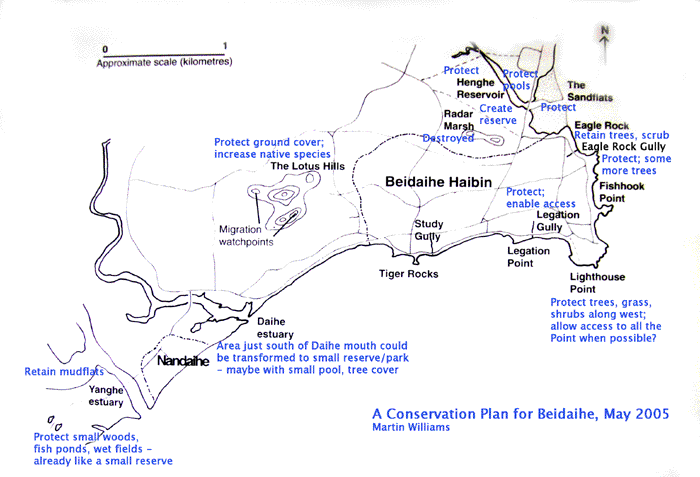
Conservation Plan for Beidaihe
Introduction This plan was originally prepared following a visit I made to Beidaihe in May 2005, at the request of Mr Cao Ziyu,…

Checklist of Beidaihe Birds
For species listed in Birds to Watch 2: The World List of Threatened Birds, codes used are: (CR) – critically endangered; (EN) -…

Beidaihe Can Create an Exciting Bird Reserve
[Based on speech I gave to audience inc leaders, at Beidaihe in May 2009] I first visited Beidaihe in spring 1985, as leader of…
Beidaihe Birding Notes May 2005
Just back from Beidaihe (east China) – for bird race commemorating 20th anniversary of team including me pitching up for first survey since…
Beidaihe autumns conclusions
Autumn migration at Beidaihe 1986 to 1990 conclusions Table of ContentsAutumn migration at Beidaihe 1986 to 1990 conclusionsHAZARDS FACING MIGRANT BIRDS AT BEIDAIHECONCLUDING…
Beidaihe autumn report – species accounts
Beidaihe autumn bird migration report (1986-1990): species systematically treated Table of Contents[Open][Close]Species systematically treatedBitterns, egrets and heronsSpoonbills, Ibises, StorksSwans, Geese, Shelducks and DucksRaptorsPartridges, pheasants…
Beidaihe – Bird Migration Hub of the Orient
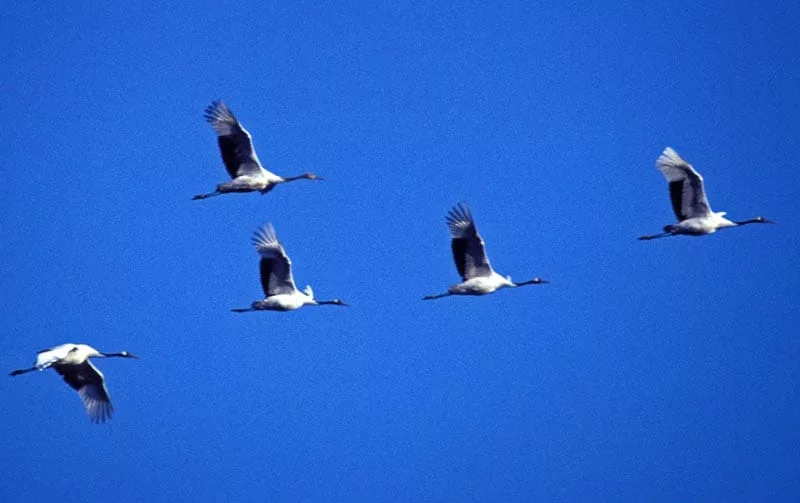
I first visited Beidaihe, a resort on China’s east coast, in spring 1985, and have returned each year since, mostly as leader or…