Philippine eagle

DomingoTadena

Keeper of the Kings

One man's perseverance offers hope to a critically endangered bird of prey

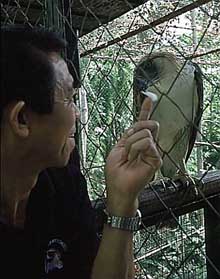
On a warm, sunny morning on the island of Mindanao in the southern Philippines, Domingo Tadena stands on a metal platform beside a roomy cage, watching a male Philippine eagle Pithecophaga jefferyi prepare to eat a young chicken. The massive, regal bird grasps the meal with a talon almost the size of Tadena's outstretched hands. Hunching, it dips its head and rips a chunk of flesh from the dead chicken with its imposing, razor-sharp bill.

Domingo Tadena, a lean 55-year-old with a weather-creased face, is no stranger to this bird. Pag-Asa (Tagalog for "Hope") is the first Philippine eagle to have been bred at the Philippine Eagle Centre, an eight-hectare encampment low in the foothills of Mount Apo.

The centre, which is dedicated to saving this critically endangered species, houses 23 eagles and chicks and employs 15 people. "The eagles are like family to me," says Tadena, who heads the centre's captive-breeding programme and calls the bird "king of the forest."

Philippine Eagle Mindanao

Bringing Back Ol' Blue Eyes

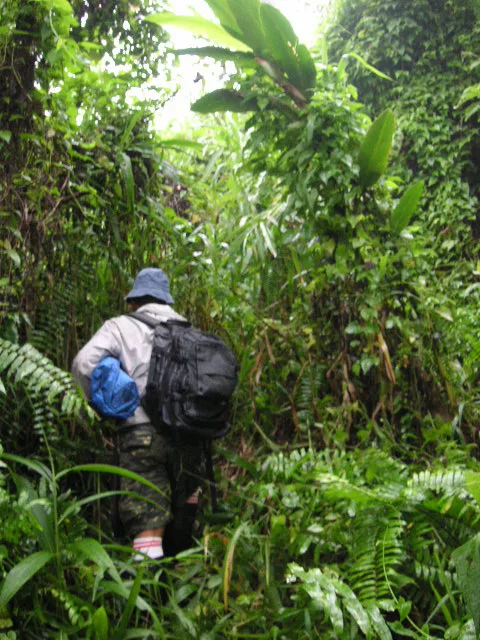
Skidding through dark mud, I clutch a bamboo stem to pull myself up the faint trail, brushing through knee-high grass that’s still wet from overnight rain. Ahead of me, one of my traveling companions, Perfecto Balicao, is making fluid, easy progress, pausing only to use his machete to cut the thin branches overhanging the path. Below us lie steep fields of maize stubble, rolling farmland and grassy hillsides.

We’re climbing a spur of Mount Sinaka, a squat hill on Mindanao in the southern Philippines where farmland gives way to scrub and rain forest, in search of one of the world’s most magnificent and endangered birds: the Philippine eagle, dubbed “the world’s noblest of flyers” by aviator Charles Lindbergh. Accompanied by biologist Jayson Ibanez, field research coordinator for the Philippine Eagle Foundation (PEF), I’m on a six-day expedition to investigate how the fate of this rare species intersects with the lives of farmers like Balicao.

With a 6.5-foot wingspan, the Philippine eagle soars over forests where—in a country naturally free of leopards and tigers—the bird is top predator. On two previous forays into Philippine eagle country, I’ve twice seen the raptors in the wild, admiring their steely bluish-grey bills roughly the size of my hands and claws that could almost encircle my neck. The Philippine eagle is one of the world’s three largest eagles (the others are the harpy eagle and Steller’s sea eagle). And it is the only bird of prey with blue-grey—as opposed to yellow, orange or brown—eyes. Known to live on just four of the country’s islands, only about 500 pairs of the eagles exist today.

Syndicate content